
An Artist's Odyssey, 39 seconds, 2026
Stop-motion animation, white paper, black paper, white cardboard, parchment paper, light box, small light panel
Artist Statement
In William Kentridge’s Black Box: Between the Lens and the Eyepiece, Kentridge explores the topic of art being a set of illusions through which we fool the viewer. “The child who plays with shadows delights not just in seeing the image of a creature on the wall, but also in watching and grasping the illusion, in learning how shadows of hands can be transformed into animals.” (pg. 47). Kentridge explains how the viewer, through suspension of disbelief, knows that whatever visual projection they are watching is not real, but their brains cannot stop themselves from seeing the intended shapes and figures the artist made for the projection. He explores the point of view of the viewer, but I wanted to explore through my own art, the other side. The point of view of the artist, the “magician” of these illusions. Through Kentridge’s reading, I really got inspired to explore the illusion aspect of art making. Art is a set of illusions that imitate, in varying degrees, real life. “Art imitates life”. That is why I decided to be very technical with my illusions.
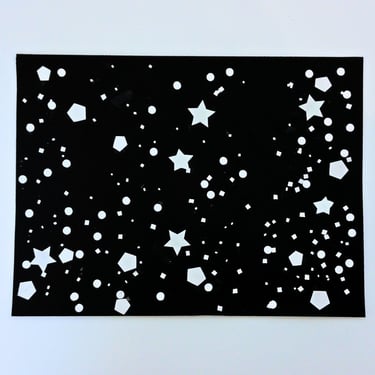
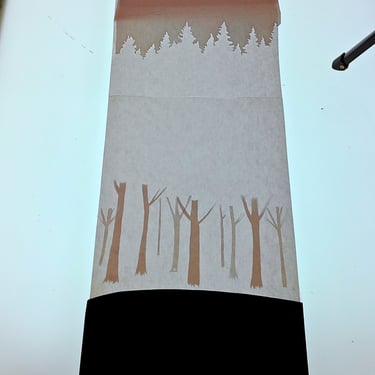
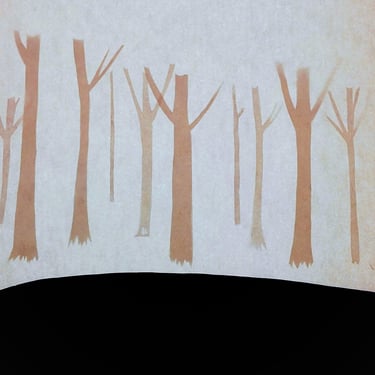
The first aspect of this set of illusions was the play of light and dark values. I really enjoyed doing this by using the different ways to create light and darkness. The parchment paper for the foggy clouds to make the illusion of transparency, the layering of office paper to make the illusion of the forest trees being farther away, and the opposite effect was used for the tree trunks, which were inspired by Lotte Reiniger’s film Adventures of Prince Achmed. She uses black color for the close-up trees in a scene with a lake and trees, and she uses negative shapes for the trees that are farther from the lake, to make the illusion of them being far away. I did something similar by gluing 2 layers of office paper for the nearest trees (along with making them a bigger shape), and for the “farthest” trees, I used 1 layer of office paper and a thinner type of paper for the ones that were the farthest, and making them thinner, consecutively. I also experimented with the use of literal light. For the first scene of my animation, I didn’t use any light in a darkened room, which actually made the black background more intense, just like you see the black color surrounding the galaxy.
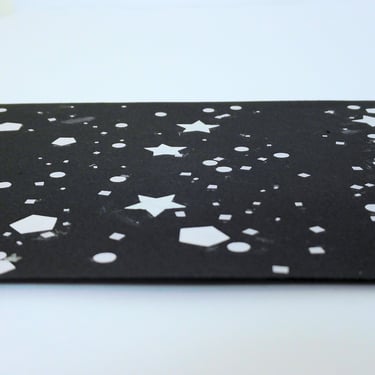
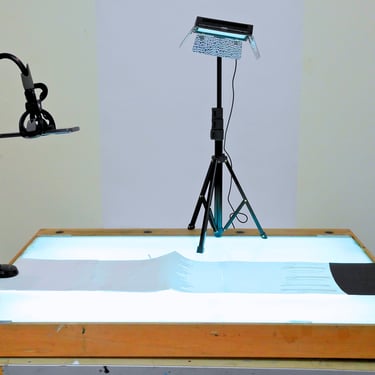
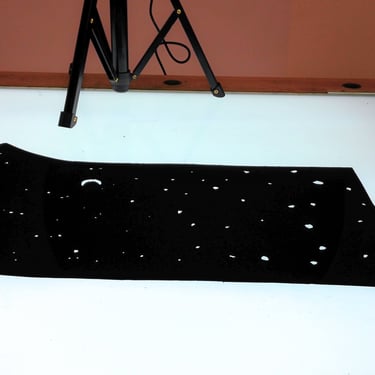
For the metamorphosis scene, I used a light lamp table underneath the background, with circular shape cutouts for the stars, which is similar to how we see stars “shine” in our sky, along with a light on top to ensure the white figures are clearly seen. The other set of illusions I used was imitating the perspectives and sizes of the distances in correlation with objects that happen in real life. With the stars of the metamorphosis scene, I made them bigger at the top of the background, as stars would look bigger if you were at a higher altitude in the sky, and made them gradually smaller as the human figure approaches the earth. The moon only appears once the figure gets closer to the mountains, since if you were closer to the stars, you wouldn’t really see the moon, until it is actually far away and near your eyesight radar.
Also, the tree silhouettes of the forest are smaller and with less detail when the figure is still falling. Then, they get progressively larger, more separate, and with more detail as the figure approaches the ground. Just like in real life, when objects are farther, you can see more of the background and less of the object, but if you are closer to the object, you see less background, and the object takes up more space in your eyesight. Finally, the foggy clouds made of parchment paper have the opposite effect. I made them bigger near the mountains, as fog has more space when you see it in pictures of a forest from far away, looking like a thick white blanket. But if you were standing in the middle of the forest, the fog becomes translucent, like a thin filter.
One thing I would have corrected from my stop motion video is, to make the transition of the human figurine from white to black as it approaches the mountain as straight as possible, when tracing the markings of the mountain’s silhouette for the black transition. I noticed that the figurines weren’t aligning with each other that well, so as you notice in the video, the movement of the figurine looks very zig-zaggy. Another thing I learned from my animation project was actually a piece of advice I would give to future students regarding this amazing project: You can definitely become really passionate about this assignment and go all out, if you want to.
To ensure that goal, make sure you don’t procrastinate, and that you are willing to put in the work, and plan your free time well. But also, it is totally fine if you want to do a simpler option. The advantage of that is that you can be easier on yourself. As long as you are truly learning from the objectives of the assignment and improving as an artist, that's all that matters. Overall, I do believe I was really successful with my project, and it turned out just how I had pictured it in my mind.
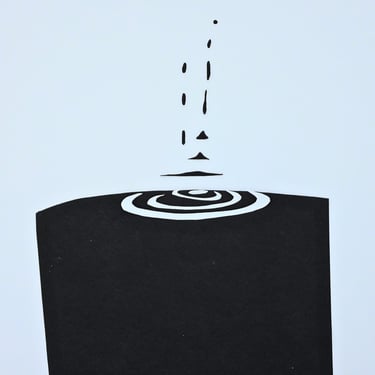
The concept behind my stop motion animation regarding metamorphosis as a representation of yourself is that I see myself mainly as a creative person, an artist. That is why the first representation of myself is of a star. The star starts to shake and turns into a meteorite, which is another way to represent the visual metaphor of an idea represented by a “lightning bolt” in a lot of animations. The shooting star starts to fall to Earth from the galaxy, to the high altitudes of our sky, and then to the lower sky. This represents the desire of the idea, as an artist, to make it “reality”. What I mean by that is by moving the idea from my mind into physical art. Whether it is a craft, photography, a poem, a song, or whatever idea I get. The metamorphosis stage of the shooting star transforming into a human represents how I, as a mere human, function as a vessel for the idea. I originally had the idea of having the shooting star be the one to dive into the lake and come out as the fairy, but this idea didn’t have a clear metamorphosis, which is why I added the human in between the two. This idea was also partially inspired by the TED Talk video with Elizabeth Gilbert that we saw during class. She talks about us (humans) being vessels for ideas and creativity, whether it is from God or from our own minds. It also represents the process of art making. Just like the laborious, lengthy process of making the stop motion animation, which I think is pretty meta. The human (myself) diving into the lake and taking its final form as a fairy represents the creative idea taking its final form.
Artists make magic, art feels magical, but at the same time, it “lives” on this Earth. Once it leaves your mind and you transfer it through the art process to the minds of the viewers, it becomes part of real life. So the magical fairy living on Earth represents that aspect of the art and the artist. Overall, my stop motion animation represents me as an artist, and the whole process of art making, as a set of illusions that become alive and impact the real world.
Cited Works
Kentridge, William. William Kentridge, Black Box, Chambre Noire. 2005.
TED. “Your Elusive Creative Genius | Elizabeth Gilbert.” YouTube, YouTube Video, 9 Feb. 2009, www.youtube.com/watch?v=86x-u-tz0MA.
Behind the Scenes
A gallery display of the sets and puppets from the stop motion, The Artist's Odyssey


Fairy puppet made out of black paper
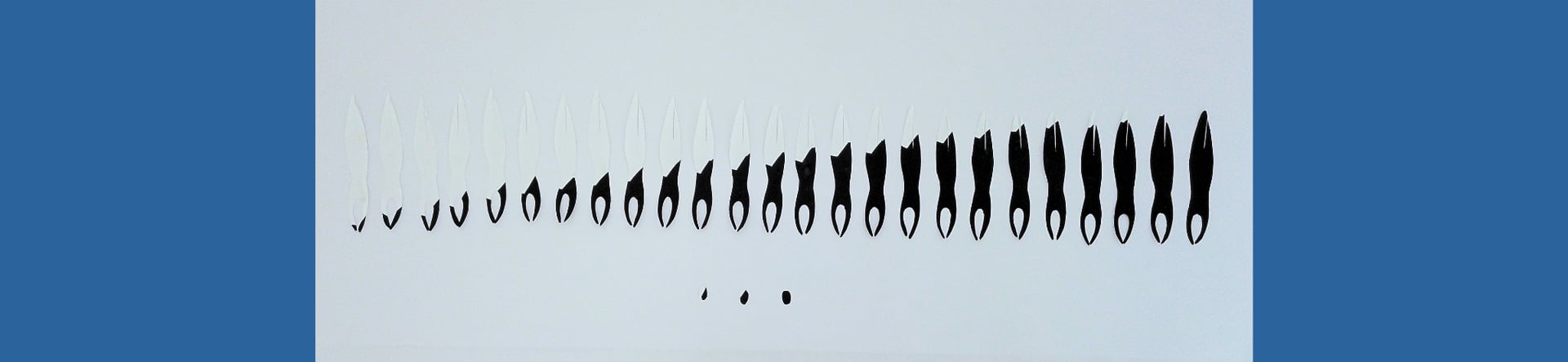



White paper cutouts for shooting star and metamorphosis
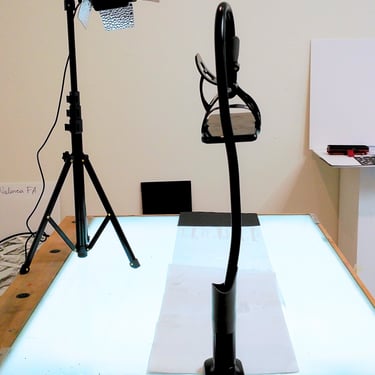
Scenery from black and white paper over a light box. A light panel was used over the scene to bring the details out. Stop motion was recorded on the phone through a stop motion film maker app.